what evidence did darwin use to support his theory of evolution
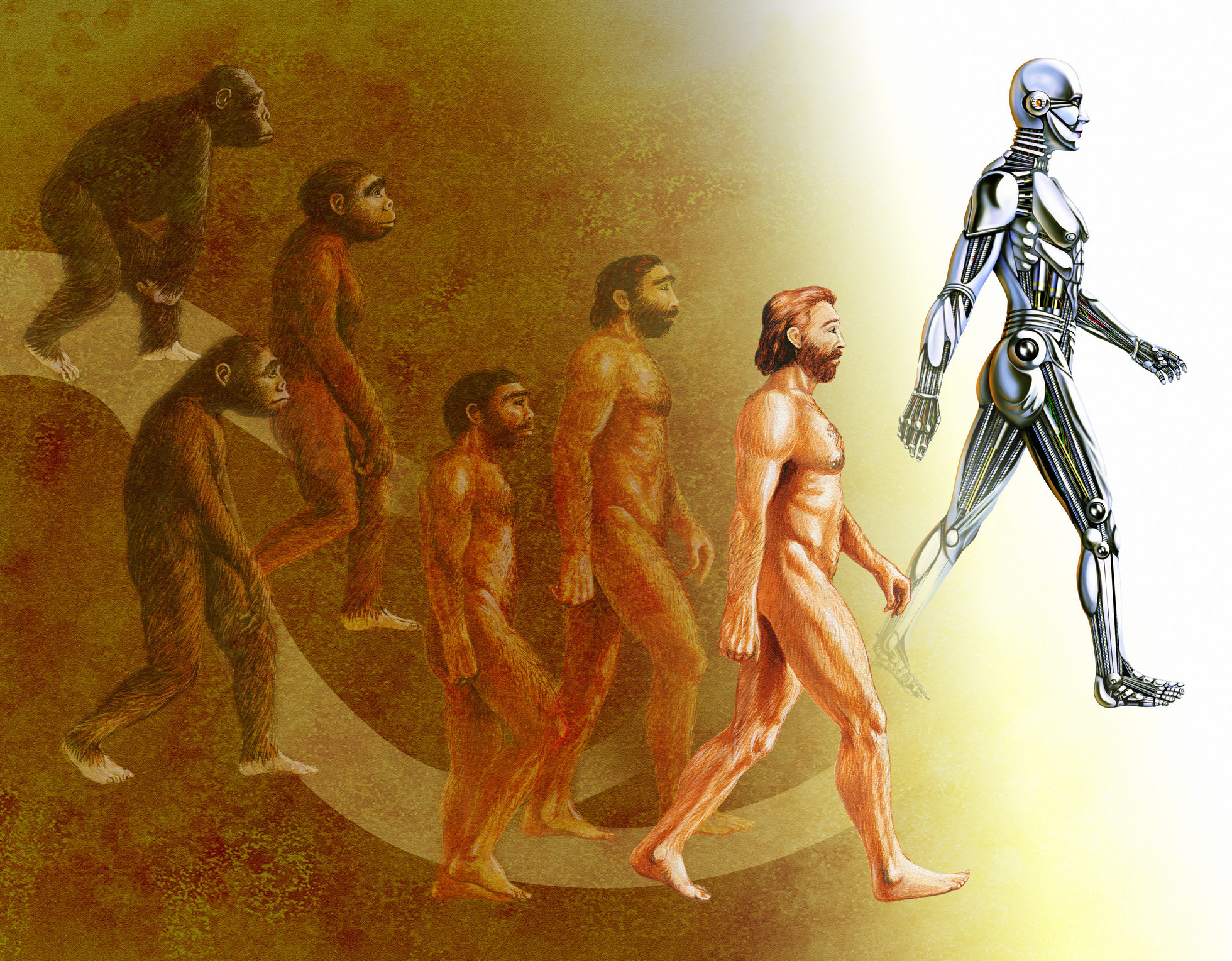 Artificial intelligence. Computer artwork depicting the evolution of a robot (far right) with bogus intelligence from a human being man (Homo sapiens, 2d from the right). The early on primate relatives of the human being are as well seen, placed along a branching evolutionary path. In the future, realistic man-like robots (androids) may possess artificial intelligence (AI). This is the power to learn and reason independently of their initial programming. Here the android is represented every bit beingness more than advanced than humans.
Charles Darwin's theory of evolution is widely regarded every bit the best explanation for life on world. Most people today believe that all species on Globe evolved from a common antecedent. In response to varying ecology conditions, members of a species learn mutations that made them more likely to survive compared to other members of their species. Over time, useful—but spont aneous —mutations prevail and species evolved.
Today scientists are building new means to empathize the evidence for evolution .
Darwin'due south piece of work laid the foundation for the field of biology to research the evolution of species . It led the written report of the reasons underlying species variation. It likewise provided an explanation for the differences between individuals in a species and why these differences matter for populations to evolve.
There are also things about life on earth, that to this day we don't understand.
Allow's explore the testify of evolution , from its history and scientific assay, since Darwin published the Origin of Species.
The History of Evolution
In 1859 Darwin presented his paradigm-changing evolution ary theory of natural option. I t was not well accepted and received broad criticism. Today many people even so disagree with the theory of evolution. All the same , that is the nature of scientific progress.
Darwin wasn't the only advancement in building the evidence for evolution.
Over the course of the past century or more, the discoveries of Gregor Mendel, James Watson, Francis Crick, and several other biologists have added to our understanding of genes, natural selection, and development.
Before Darwin , philosophers and scientists had put forth theories that laid the foundation for development . Going back thousands of years, various entities had speculated about the origin of species.
Cosmos vs. Evolution
The theory of development began with ideas founded in creation or creationism.
Let's wait at the timeline of how creation, became a theory of evolution. Several theories put forward before Darwin's time had had some level of Creationism.
- In the 1700s , Car o fifty us Linnaeus—famous for his system of nome n clature and classification —suggested that many species were hybrids that had evolved from others placed on Earth by God.
- In 1794, James Hutton, a leading geologist, was the first to theorize natural selection , without terming it as such . Hutton used the instance of artificial selection to explain evolution. Members of a species varied, those that better suited their environment flourished, while others lacking such advantages did non.
- In the aforementioned yr, Charles Darwin's grandad, Erasmus Darwin, wrote a book called Zoonomia . He suggested that the strongest members of a species were more probable to survive. He also pushed for a common origin theory. But unlike his more lauded grandson, Erasmus Darwin's ideas were speculative with niggling evidence to back them.
Different Theories of Evolution
- In 1809, Jean-Baptiste Lamarck put along his theory of transmutation that came to be the strongest contender to Darwin'due south theory of natural selection . Tussles between Lamarckism and Darwinism continue to date. According to Lamarck , all species did non share a common ancestor but some basic forms had been created spontaneously from which others had evolved . He did concur that species changed in response to their environment. Moreover, offspring inherited those changes that were most frequently enacted. These inheritable changes led to evolution of a species.
- In 1844, Robert Chambers' book Vestiges of the Natural History of Cosmos , was published. In it, he proposed theories on not only the origin of humans but also the solar organisation. He suggested humans were the terminal i n a line of species that had evolved from a mutual ancestor.
- Not long before Darwin and Wallace came into the flick, William Charles Wells had acknowledged the existence of natural selection—at to the lowest degree in humans. While Darwin had not come up across Wells' work, he later admitted that Wells' had been the first to understand natural selection.
While bits and pieces of Darwin's theory had been worked on past other scientists, philosophers, and even clergymen over the years. But Darwin and Alfred Russell Wallace were the first to cohesively bring these different ideas together equally well as back it with scientific testify. Wallace had preceded Darwin with a ready of papers on evolution but over time was pushed to the sidelines .
What is Natural Selection in Evolution?
In 1831, Charles Darwin, serving equally a naturalist on the survey ship H.M.S. Beagle , set canvas for Europe and Due south America. His journey around the continents, and particularly to the Galápagos Islands off the coast of Republic of ecuador would provide compelling testify for evolution.
In the five years, while Darwin was aboard the ship, he often went on state to avoid the seasickness that plagued him on the high seas. He observed the flora and fauna of Due south America and Europe. He noted down the many differences between the creatures found on the two continents. Darwin also noticed the similarity between species from dissimilar biomes on the same landmass.
For case, he plant that the animals in the temperate zone of South America were more similar to those in the continent's tropical zone compared to those in the temperate zone of Europe. He learned that different animals favored the various Galápagos Islands and seemed to have evolved independently on the islands. The species of animals on Galápagos likewise seemed like to those found in South America. This raised the possibility that they may have diverged from animals on the mainland at some point in fourth dimension.
Darwin had plant that species around the world appeared to take adapted to their specific environment. Thus, development seemed to exist a product of the natural world. Creatures effectually the globe had been molded through accommodation to adapt their surroundings. Darwin was of the stance that individuals that could suit to their surround survived. Those that couldn't, grew sparse within a population, before eventually dying out. In this way, a population evolved as a whole. This procedure, Darwin chosen, natural choice.
v Ways to Draw Evidence for Evolution
Darwin had proposed his theory in The Origin of Species . Born in 1904, Ernst Mayr , an evolutionary biologist, is known for his piece of work on the definition of species. Mayr's piece of work on speciation was inspired by Darwin'south and brought mod testify of evolution .
In addition to this, he put forth his ain spin on Darwin's theory of development and natural option.
Mayr distilled information technology to five observations from which he inferred three aspects of evolution.
Observation 1
Generally, populations of organisms have high fertility rates. If they reproduced unabated, their population would rise uncontrollably. For example, if ane bacterium was to give rise to two bacteria, the bacterial population growth over time would be exponential—from 1 to ii to four to eight and so on. In under a week, the progeny of a single Escherichia coli could weigh about as much as planet World.
Here's some other case: oysters. These creatures tin lay 114,000,000 eggs in one fell swoop. If all these eggs successfully matured into full-grown oysters who each went on to take as many eggs of their ain that besides all grew into adults, then 5 generations is all it would take for at that place to be more oysters than electrons in the universe. Clearly, oysters never produce enough offspring to make information technology to that listen-boggling effigy.
Thus, despite this innate ability of most species to furiously reproduce, in reality, there aren't excessive numbers of them. Something keeps a check on those numbers.
Observation ii
While theoretically, oysters and nigh creatures can multiply exponentially, the reality is quite different. The reason at that place aren't hundreds of thousands of oysters in the oceans is that well-nigh of their offspring may non have their own opportunities to reproduce.
Many a number of them volition die from starvation, predation or infection. Outside of temporary ups and downs, population sizes tend to remain abiding. Thus, fifty-fifty though an oyster produces 114,000,000 eggs, only a beggarly two of that number are likely to go on and reproduce successfully.
Observation 3
Natural resource available to species are in brusk supply. The planet's resources are limited.
From these three observations, Mayr proposed the following.
- Mayr's starting time inference
Equally resource are constrained, a blast in the population can mean little to become effectually. Thus, only the number of individuals that tin be supported by the environment will survive. Organisms demand to compete with other members of their species. This struggle for resource means that simply a small percentage of offspring volition survive.
According to Darwin, this struggle was non only between organisms belonging to a species but also betwixt organisms and their environments. Thus, the environment was what kept the population numbers restrained.
Observation 4
Despite belonging to the same species, members tin can exist very different from each other. Co-ordinate to Darwin, these variations were the very lifeblood of evolution.
Observation 5
Darwin also understood that family unit members tended to share some traits. Thus, variations in characteristics tin be inherited.
Darwin knew that both these principles were crucial for natural option to occur. Merely, he could not justify the existence of variation and how traits are passed downwards.
At the time of Darwin's proposal, the study of genetics was nonexistent. Dna hadn't been identified. Now, the molecular causes for variation are known. Random mutations and recombinations of genes effect in new traits—exist they helpful, harmful, or neutral.
- Mayr'south second inference
Using these ii observations, Mayr explained that these differences betwixt organisms belonging to the same species influenced the likelihood of their survival. Individuals who were most suited for their surround were more probable to succeed. These members were besides more than likely to leave behind greater numbers of progeny.
- Mayr'due south tertiary inference
From two of his inferences, Mayr drew his last conclusion about Darwin's theory.
- Thousand ost species would overproduce were information technology not for environmental pressures.
- I ndividuals of the same species display different traits that passed from parent to progeny.
- Such individuals will produce more offspring than those with scarce traits will produce.
While these beneficial traits arise in a random way, their distribution among the population is anything but random. This is because organism due south within a population with favo rable characteristics are selected for survival.
The struggle for survival is not based purely on gamble. While expert traits arise randomly, their distribution in the new generation is non-random—provided the trait is needed for reproduction and the very existence of the organism.
Inherited traits possessed by some individuals of a species that make them meliorate fit for the environment would win out over other less beneficial traits. This inequality of reproductive success across a species is not random. It volition eventually consequence in a population with beneficial characteristics.
Thus, populations evolve as a whole, non individuals alone.
Conclusion
A modern lens on natural selection and evolution creates some interesting questions.
While each and every observation and inference has been experimentally established, neither can drive evolution lone. If all the numerous individuals belonging to a species were similar and variation were not inherited, natural selection would not be enforced.
On the other paw, natural selection will almost always occur provided all of Darwin's propo sals are met. Equally a result, favo red genes are passed to the offspring at a higher frequency than unfavo rable traits.
This unequal split up upwardly among the population is repeated with every generation and its effect is aggregated over several rounds of reproduction. Amend and amend traits volition grow in a population as parents possessing them to leave behind more than children.
In this fashion, the population gradually changes to reflect beneficial traits. While the organism may be changing, information technology is the population that evolves.
We will be discussing development further in respects to advances in the epigenetics of natural pick and quantum biology.
Now it'south upward to you lot.
Practise you think Ernst Mayr'southward observations provide bear witness for evolution? Leave your thoughts in the comment section beneath.
Farther reading:
- https://link.springer.com/commodity/ten.1007/s12052-009-0128-1
- https://world wide web.amazon.com/Life-Science-William-Thou-Purves/dp/0716798565
- https://www.scientificamerican.com/commodity/the-evolution-of-ernst-in/
- https://early on-development.oeb.harvard.edu/
About the Author(s)

Source: https://humanoriginproject.com/new-human-evidence-of-evolution-darwins-theory/
0 Response to "what evidence did darwin use to support his theory of evolution"
Post a Comment